For nine years the Haskett brothers had sat on opposite sides of the aisle at Pruett’s Crossing Community Church, and by now nobody said a word about it.
Lyle and Peggy took the fourth pew on the left, where Hasketts had sat since the church was built in 1911. Dwight and Arlene took the fourth pew on the right. When the offering plate came down, the ushers handed it across the gap without looking at either one of them.
Then in October the congregation voted to pull up the old red carpet, which had worn through to the boards in front of the pulpit. The pews went out on a flatbed to Orville Tate’s machine shed. For six Sundays, Pastor Mae Odom announced, worship would be held in the fellowship hall on folding chairs.
“I’ll need hands Saturday evening to set up,” she said. “Seven o’clock. Bring your back.”
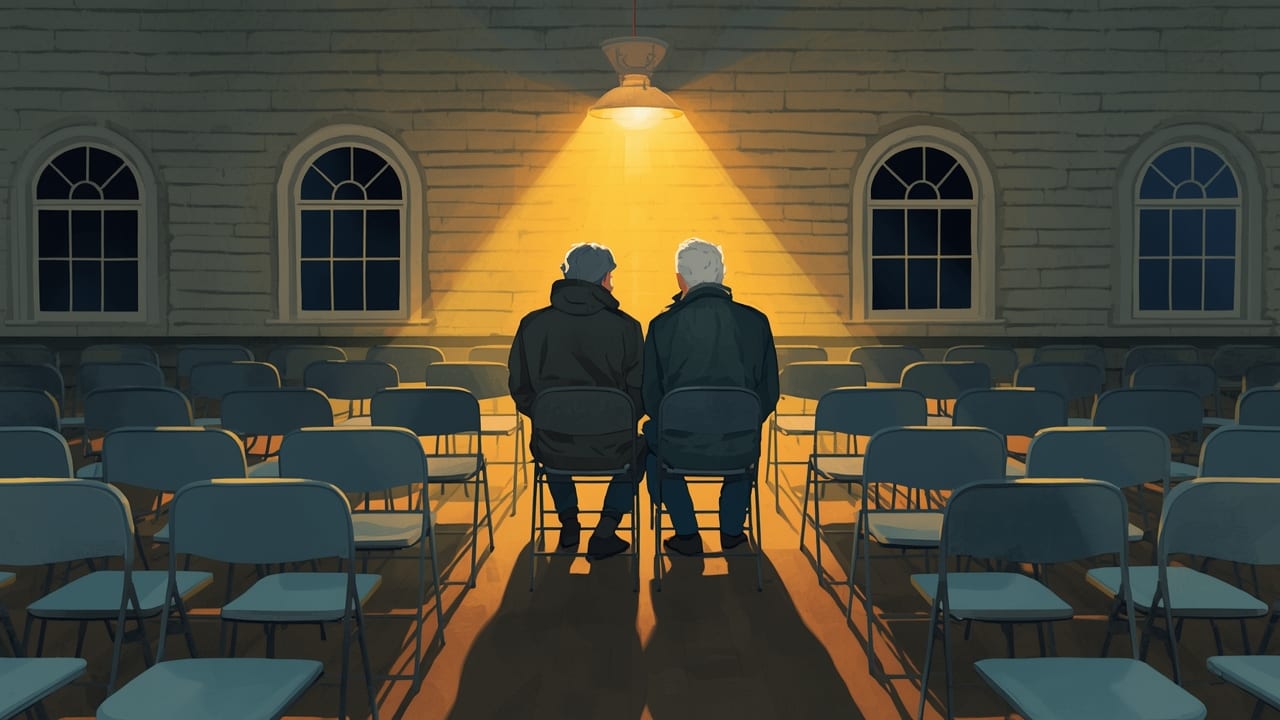
Lyle got there at ten till. The fellowship hall smelled of coffee that had sat on the burner since the men’s breakfast, and of the pine cleaner the church used on everything. The chairs leaned in a rack against the far wall, gray metal, a hundred and twenty of them.
He heard a truck door outside and knew the sound of it before he looked. Dwight came in carrying a pair of work gloves, saw who was there, and stopped just inside the door.
Nobody else came. Lyle found out later that Pastor Mae had told the youth group to come at eight.
They worked without talking. Dwight started at the left wall and Lyle started at the right. They unfolded chairs and set them in rows that crept toward each other across the linoleum. The heater ticked. A sparrow that had gotten in somewhere hopped along the windowsill.
When the rows were nearly touching, both men straightened up at the same time.
“You want an aisle,” Dwight said. It was the first thing he had said to his brother since the parking lot after the funeral.
Lyle looked at the space between the rows. About four feet. The width of a pew end.
“Dad always said a church needs an aisle,” Lyle said, “so the bride’s got somewhere to walk.”
“Dad said a lot of things.”
The parking lot came back to Lyle whole. Dwight just in from Columbus with the road still on him, standing beside the empty spot in the shed where the old red tractor had been. Their father had taught both boys to drive on that tractor, one at a time on his lap, the steering wheel bigger than their chests.
Lyle had sold it, as far as Dwight knew, two days before Dwight got home. Dwight had said things that afternoon in front of half the congregation. Lyle had said things back. Then he had gone home and not called, and Dwight had not called, and somehow that had become the rest of their lives.
Dwight pulled off one glove. “I’d have paid you for it. Whatever the man gave. I’d have paid double.”
“I know it.”
“Then why?”
Lyle sat down on the nearest folding chair. It creaked under him. He had carried the answer so long it had worn smooth, like a stone in a pocket.
“Because it was already sold,” he said. “Dad sold it to Ferris Kemp in March, before the last hospital stay. The bills had gotten that far. He made me promise not to tell you. Ferris left it sitting in the shed so you wouldn’t see it gone while Dad was living.”
Dwight stood very still.
“He said you’d worry yourself sick from three hundred miles off and couldn’t do one thing about it,” Lyle said. “He said, ‘Let the boy have one less thing.’”
“Nine years,” Dwight said.
“I meant to tell you after. Then you said what you said in that parking lot, and I decided you could just go on not knowing.” Lyle turned his cap around in his hands. “That part’s mine. I can’t hang that part on Dad.”
Dwight pulled out the chair across the gap and sat in it, so their knees nearly touched over the empty space. For a long while he didn’t speak.
“I wasn’t there,” he finally said. “You called me Tuesday and said come, and I told you Friday, after the job closed out. Friday.” He shook his head. “I yelled at you about a tractor because I couldn’t yell at myself about Friday.”
The sparrow lit on a chair back three rows over. Neither of them moved.
“He asked for you Tuesday night,” Lyle said. “I told him you were already on the road. That wasn’t true either. But he smiled at it.”
Dwight put his face in his hands. Lyle reached across and set his palm on his brother’s shoulder, the way their father used to steady them on the tractor seat when the ground got rough, and he left it there.
The youth group came in at eight, loud as a flock of crows, and found the two Haskett men sweeping. Every chair was up. There was no aisle.
“Pastor Mae said there’d be an aisle,” said Trina Odom, who was fourteen and took her mother’s instructions seriously.
“We took a vote,” Dwight said. “Two to nothing.”
On Sunday morning Peggy came in with a pan of cinnamon rolls for the coffee hour and found her husband in the fourth row with his brother beside him. Arlene came in a minute later and stopped in the doorway.
The two wives looked at each other over their husbands’ heads. For nine Christmas Eves, Arlene had left a pound cake on Peggy’s porch with no note, and Peggy had left a jar of chow-chow on Arlene’s. Neither had ever mentioned it. Arlene sat down on Dwight’s other side, and Peggy sat on Lyle’s, and that was the whole of the conversation.
Pastor Mae had to squeeze sideways down the wall to reach the little lectern, since there was no aisle to walk. She had chosen the reading back in August. She did not look at the fourth row when she read it, and later she swore she had not changed a word.
“And Esau ran to meet him, and embraced him, and fell on his neck, and kissed him: and they wept.” (Genesis 33:4)
Lyle didn’t hear much of the sermon after that. He was thinking about a steering wheel as big as the world and a man’s arms on either side of him.
After the benediction, Ferris Kemp leaned forward from the fifth row and tapped both brothers on the shoulder.
“She’s still in my shed,” he said. “Battery’s dead, but she’ll turn over with a jump. Your daddy told me to hold on to her. Said someday you two would come for her together.”
Dwight was already fishing his truck keys out of his pocket.
“I’ll bring the cables,” he said.
“You drive,” Lyle said. “I’ll ride the fender, like we used to.”
Did this story lift you up?
Share it with someone
Up next

A Lesson in Faith - The Charles Blondin Story
Tightrope walker Charles Blondin crossed Niagara Falls, then asked a cheering crowd who would ride in his wheelbarrow. A clear picture of what real faith means.