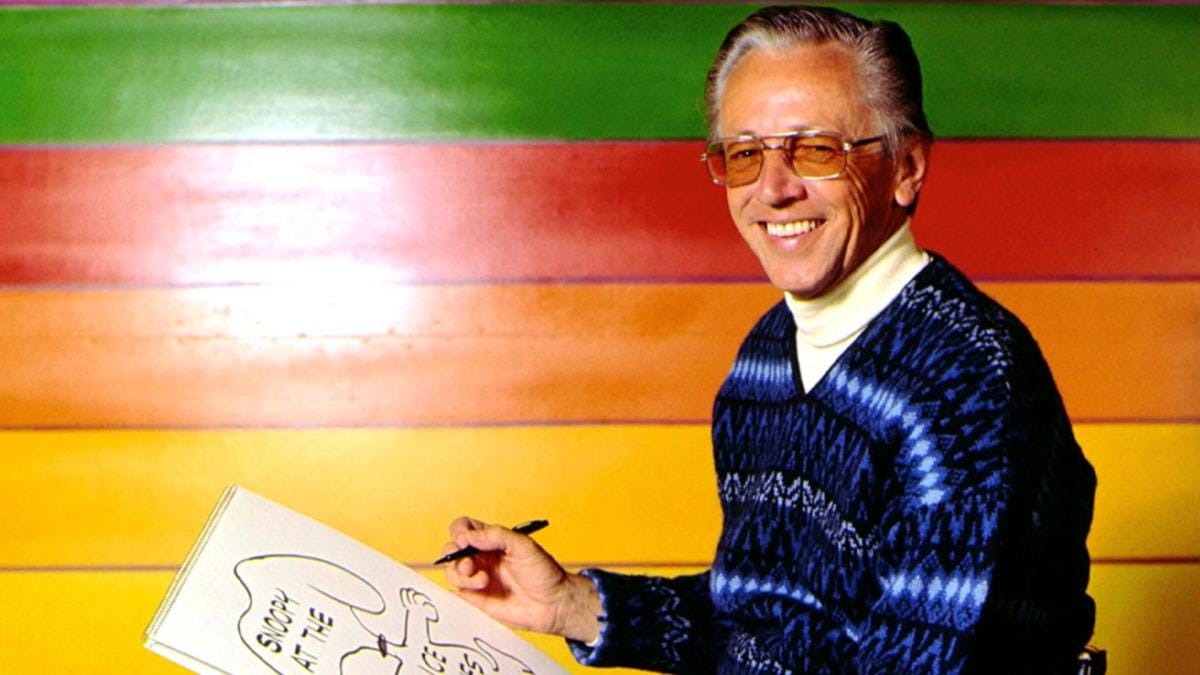
Creator of the “Peanuts” Gang
The late Earl Nightingale, writer and publisher of inspirational and motivational newsletters, once told a story about a boy named Sparky. For Sparky, school was all but impossible. He had been bright enough to skip ahead in grade school, but by high school he was struggling badly, and he routinely flunked classes.
He didn’t get much credit outside the classroom, either. He played a superior game of golf, yet at school nobody seemed to notice.
Throughout his youth Sparky was awkward socially. He was not actually disliked by the other students; no one cared that much. He was astonished if a classmate ever said hello to him outside of school hours. There’s no way to tell how he might have done at dating. Sparky never once asked a girl to go out in high school. He was too afraid of being turned down.
Sparky was a loser. He, his classmates, everyone knew it.
However, one thing was important to Sparky: drawing. He was proud of his artwork. Few people gave him credit for it. In his senior year of high school, his art teacher asked him to draw scenes of school life for the yearbook. When the yearbook came out, none of his drawings were in it. Despite this rejection, Sparky held on to his dream of becoming a professional cartoonist.
The story is often told that after high school he tried for a place at Walt Disney Studios and was turned down once again. Another loss for the loser. (Accounts differ about his dealings with Disney; see “Is It True?” further on.)
In time, Sparky decided to write his own autobiography in cartoons. He described his childhood self: a little boy loser and chronic underachiever. The cartoon character would soon become famous worldwide. Sparky, the boy who struggled in school and whose work was rejected again and again, was Charles Schulz. He created the “Peanuts” comic strip and the little cartoon character whose kite would never fly and who never succeeded in kicking a football: Charlie Brown.
Press on toward the mark … Don’t you ever give up!
The Rest of the Story
Added by the Inspire21 editors and checked against the sources below.
Charles Monroe Schulz was born on November 26, 1922, in Minneapolis, Minnesota. He was an only child. His father, Carl, was a barber of German descent, and his mother, Dena, came from a Norwegian family. When he was just two days old, an uncle nicknamed him “Sparky,” after Spark Plug, the horse in the comic strip Barney Google. The name stayed with him for life.
His gift showed early. In kindergarten a teacher told him that one day he would be an artist. At Richards Gordon Elementary School in St. Paul he skipped two half-grades, which made him the youngest in his class. He was shy, and he was bullied.
He entered St. Paul Central High School in 1936. In 1939 he signed up for a correspondence course from Art Instruction, and he graduated in 1940.
Then came a hard season. In February 1943 his mother died of cancer at just 50 years old, and days later he shipped out for Army service in World War II. He trained as a machine gunner at what was then Camp Campbell, Kentucky, rose to staff sergeant, and was sent to Europe in February 1945. He earned the Combat Infantryman Badge and was discharged on January 6, 1946.
Home again, he lived with his father above the barbershop in St. Paul. That same year he joined the Church of God, an evangelical church. In July 1946 he went to work for Art Instruction, the school whose course he had taken, grading students’ work. Later he became an instructor there.
Little by little, doors opened. In 1947 his one-panel cartoon “Li’l Folks” began running in the St. Paul Pioneer Press, and in 1948 and 1949 he sold cartoons to the Saturday Evening Post. In 1950 United Feature Syndicate took on his strip and renamed it “Peanuts,” a name he disliked. It started in only seven newspapers. That same year, Donna Wold, the red-haired woman he loved, told him she was marrying someone else.
He married Joyce Halverson in 1951, and in 1958 he moved the family to Sebastopol, California. That marriage ended in 1972, and in 1973 he married Jean.
In 1965 Peanuts was on the cover of Time, and “A Charlie Brown Christmas” aired, winning an Emmy and a Peabody. In 1969 the Apollo 10 astronauts named their spacecraft Charlie Brown and Snoopy and took them to the Moon.
In 1981 he had heart bypass surgery, and afterward his hand was shaky. He kept drawing. For nearly 50 years he wrote and drew every strip himself, 17,897 of them by the museum’s count. In 1996 he received a star on the Hollywood Walk of Fame.
In November 1999 a stroke put him in the hospital, and doctors found colon cancer. On December 14, 1999, he announced his retirement. By then Peanuts ran in more than 2,600 newspapers, with book collections in more than 25 languages. The last daily strip ran on January 3, 2000.
Charles Schulz died in his sleep at home in Santa Rosa, California, on February 12, 2000. The very next morning his final Sunday strip appeared, with his farewell to his characters. On May 27, 2000, many comic strips ran tributes to “Sparky.”
The Charles M. Schulz Museum opened in Santa Rosa on August 17, 2002. And at Central High, the school whose yearbook left out his drawings, a statue of Snoopy now stands in the main office.
Is It True?
Did Sparky fail eighth grade? We found no reliable source for this. It comes from a well-known inspirational chain story. In fact, he skipped two half-grades in elementary school. His real struggles came in high school, where he routinely flunked classes.
Did he lose at golf and fail at sports? The tale of losing the big match and the consolation match appears only in the chain story. Time reported that he played a superior game of golf and was never given credit for it.
Was he really rejected by his high school yearbook? Yes. In 1940 his art teacher asked him to draw school scenes for the senior yearbook, and none of them were printed. He stayed baffled by it for the rest of his life.
Did Disney turn him down? Accounts differ. Newsweek’s summary of David Michaelis’s biography says Disney told him he was not qualified to work as an animator. Another account says the opposite: while he was drawing “Li’l Folks,” Disney offered him a try-out, and he turned it down because he didn’t want to be a small part of a big studio.
Was he turned down by every publication? That is overstated. Collier’s and the Saturday Evening Post did reject his early cartoons, but the Post later bought his work, and “Li’l Folks” ran in the Pioneer Press from 1947.
Did he say, “The Army taught me all I needed to know about loneliness”? This line appears in the chain story with no original source, so we can’t confirm he said it.
Why did the red-haired girl say no? Schulz told friends that Donna Wold turned him down because her mother disliked him. The Michaelis biography, as reported by Newsweek, says the decision was hers alone.
In His Own Words
Schulz once described his life as “one of rejection.”
He never forgot his school years. Remembering Central High, he said: “I don’t know which was worse - the Army or Central High School.”
At 53, he had his old high school report card printed in a book collection “to show my own children that I was not as dumb as everyone has said I was.”
He was a Disney fan, too: “Naturally, I was a Walt Disney fan and used to be able to draw quite faithfully Mickey Mouse, Donald Duck…”
And he knew his calling early. He said his ambition “from earliest memory was to produce a daily comic strip.”
A Lesson for Today
- A closed door is not the end of the story. Sparky’s yearbook drawings were left out, yet a Snoopy statue now stands in that same school’s office.
- Grief and hardship came early for him: his mother’s death and wartime service. He kept going and kept drawing.
- Faithful, steady work adds up. One strip a day, done with his own hand, became nearly 18,000 strips.
- Ask your group: Who first saw a gift in you, the way a kindergarten teacher saw one in Charles? Whose gift could you encourage this week?
Sources
- Charles M. Schulz Biography – Charles M. Schulz Museum
- Charles M. Schulz Biography & Peanuts Fun Facts (PDF) – Schulz Museum
- Schulz, Charles Monroe (1922–2000) – MNOPEDIA, Minnesota Historical Society
- Charles Schulz's life and career timeline – PBS American Masters
- Passages: The Life and Times of Charles Schulz – Time
- Schulz remembers the early days in Minnesota, before he lived on 'Peanuts' – Star Tribune
- The Dark Side of Charles Schulz – Newsweek
- Charles M. Schulz – Lambiek Comiclopedia
From inspire21.com/a-tribute-to-charles-m-schulz-1922-2000/
Did this story lift you up?
Share it with someone
Up next

Pass The Baked Beans
One day I met a sweet gentleman and fell in love. When it became apparent that we would marry, I made the supreme sacrifice and gave up beans. Some months…