Researched by the Inspire21 editors from the sources listed at the end. About our story labels
On the morning of December 7, 1941, a young sailor named Doris Miller got up at 6 a.m. aboard the battleship USS West Virginia at Pearl Harbor, Hawaii.
He was collecting laundry when the alarm for general quarters sounded.
By the end of that morning, the man whose job was laundry had carried wounded shipmates to safety, fired a machine gun at enemy planes, and helped save sailors in the burning water. His story still deserves to be told.
A Farm Boy from Waco
Doris Miller was born in Waco, Texas, on October 12, 1919. His parents, Conery and Henrietta Miller, were farmers just outside the city.
He grew into a big, strong young man: 6 feet 3 inches tall and more than 200 pounds. He worked on the family farm and played football at Waco’s A.J. Moore Academy.
In 1939 he joined the United States Navy. He wanted to travel, and his family needed his support.
The military of that day was segregated. Black sailors could serve only as messmen, and they were not taught how to operate the ship’s guns. Miller became a mess attendant.
In 1940 he was sent to Pearl Harbor and reported aboard USS West Virginia. There he became the ship’s heavyweight boxing champion. His fellow sailors called him Dorie.
The Morning Everything Changed
When the alarm sounded, Miller headed for a gun magazine in the middle of the ship. A torpedo had damaged it.
So he did what a strong man could do. He began carrying the wounded to safety.
Then he was ordered to the bridge. The ship’s captain had been mortally wounded, and Miller helped carry him to a safer place while enemy planes strafed and bombed the ship and a serious fire burned.
Next he did something no one had ever trained him to do. He loaded and fired an anti-aircraft machine gun at the attacking planes. As he fired, Lieutenant (junior grade) Frederic H. White shouted brief instructions to him.
He kept firing until he was ordered to leave the bridge.
Even then, his work was not done. After the order came to abandon ship, Miller stayed behind to help evacuate his shipmates and to save sailors in the burning water.
The Hero Without a Name
For months, nobody outside the Navy even knew who he was. He was known only as an unnamed Black messman.
Black newspapers took up his story. They pressed the Navy to recognize him.
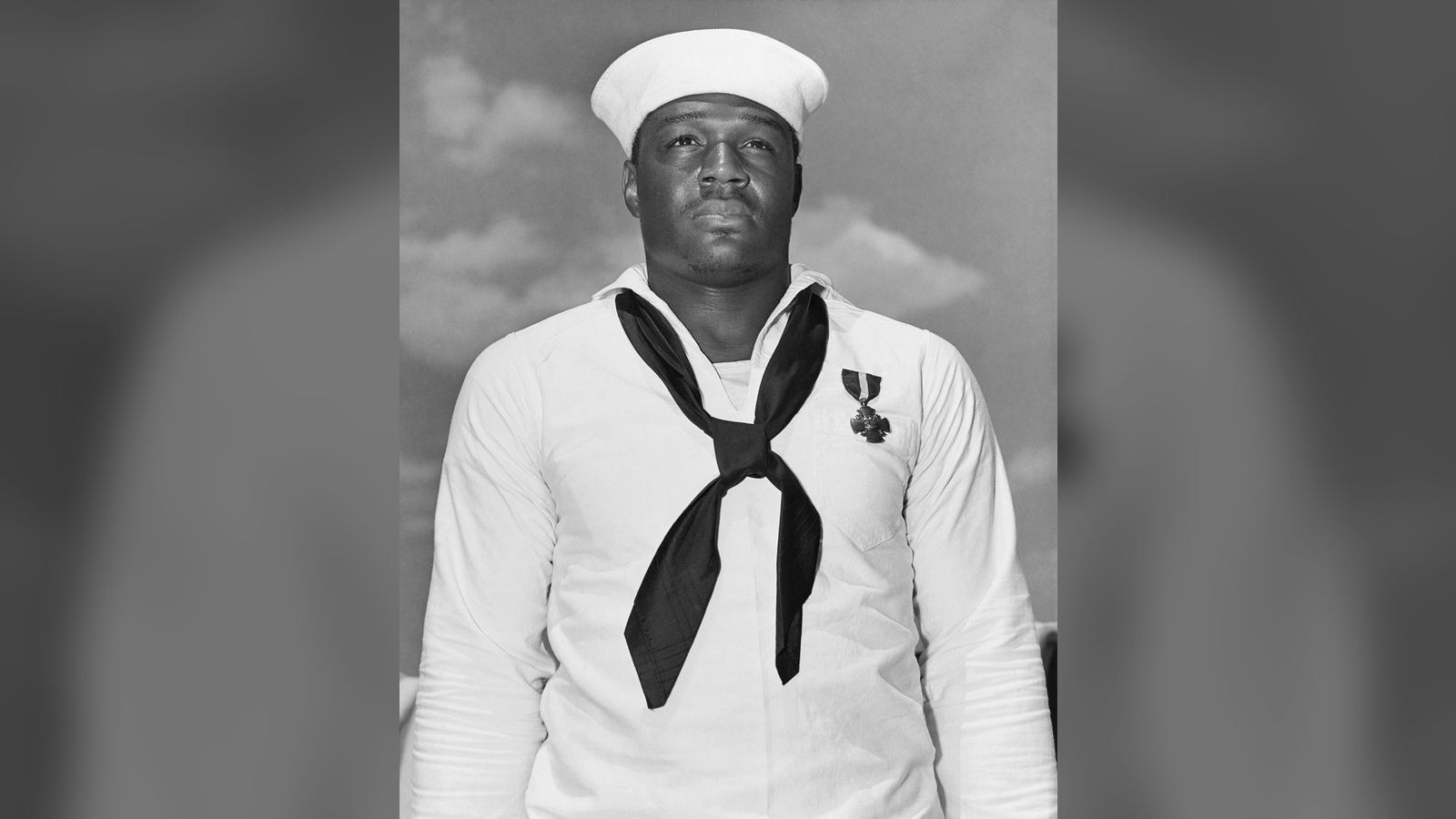
On May 27, 1942, on the flight deck of the aircraft carrier USS Enterprise at Pearl Harbor, Admiral Chester W. Nimitz presented Mess Attendant Second Class Doris Miller with the Navy Cross. He was the first African American to receive it.
He was later promoted to cook, third class.
His Last Voyage
In the spring of 1943, Miller was assigned to a newly built escort carrier, USS Liscome Bay. He was aboard during the seizure of Makin and Tarawa Atolls in the Gilbert Islands of the Pacific.
On November 24, 1943, a torpedo sank Liscome Bay off Butaritari Atoll. More than 600 men were lost. Doris Miller was one of them. He was 24 years old.
His parents were told that their son was lost in action on December 7, 1943, two years to the day after the attack on Pearl Harbor.
Along with the Navy Cross, he received the Purple Heart.
Why He Still Matters
Doris Miller did not go looking for glory that morning. He was a young man doing the humble chores he had been given, in a Navy that had not trained him to use a gun.
When the moment came, he carried the wounded. He stayed with his captain. He fired back. And when he could have left the ship, he stayed to save others.
His courage did not end unfair treatment overnight. But Black newspapers made sure the country knew his name, and a sailor sent to collect laundry became the first African American to receive the Navy Cross.
Is It True?
“He shot down several Japanese planes.” No one can say for sure. Accounts and records disagree, and his Navy Cross citation does not mention any planes at all. Miller himself only said, “I think I got one.” As Navy Times has noted, the number of planes is beside the point. What matters is what he did that morning.
“Pearl Harbor ended segregation in the military.” It did not. Miller’s bravery was important, but it did not end racism in America.
“He was a cook at Pearl Harbor.” Not quite. On December 7, 1941, he was a mess attendant, collecting laundry when the attack began. He became a cook later, after he received the Navy Cross.
In His Own Words
Looking back on firing the machine gun he had never been trained to use, he later recalled:
“It wasn’t hard. I just pulled the trigger and she worked fine. I had watched the others with these guns. I guess I fired her for about 15 minutes. I think I got one of those planes. They were diving pretty close to us.”
On how he set aside the limits placed on Black sailors that morning, Navy Times quotes him as saying:
“When the Japanese bombers attacked my ship at Pearl Harbor I forgot all about the fact that I and other Negroes can be only messmen in the Navy and are not taught how to man an antiaircraft gun.”
A Lesson for Today
- Doris Miller started that morning collecting laundry, a reminder that faithfulness in small tasks prepares us for big moments.
- He paid attention. He had watched others use the guns, and when the time came, he was ready.
- When others were hurt, he stayed. Ask your group: Who around us needs someone to stay and help today?
Sources
- Naval History and Heritage Command, "Cook Third Class Doris Miller"
- U.S. Navy All Hands, "The Story Behind an American Hero"
- Britannica, "Doris Miller"
- BlackPast, "Doris ('Dorie') Miller (1919-1943)"
- Navy Times, "How Dorie Miller's bravery helped fight Navy racism"
- Mental Floss, "Doris Miller, the Naval Cook Who Became a Hero of Pearl Harbor"
- USS Doris Miller (CVN-81)
- Doris 'Dorie' Miller
From inspire21.com/doris-miller-the-sailor-who-stepped-up-at-pearl-harbor/
Did this story lift you up?
Share it with someone
Up next

The Star Spangled Banner
The Star Spangled Banner As You've Never Heard It A MUST SEE Video for everyone ... not just Americans! Over 13 Million Views on YouTube Watch this video…