From the Inspire21 archive, collected since 2000. Original author often unknown. About our story labels
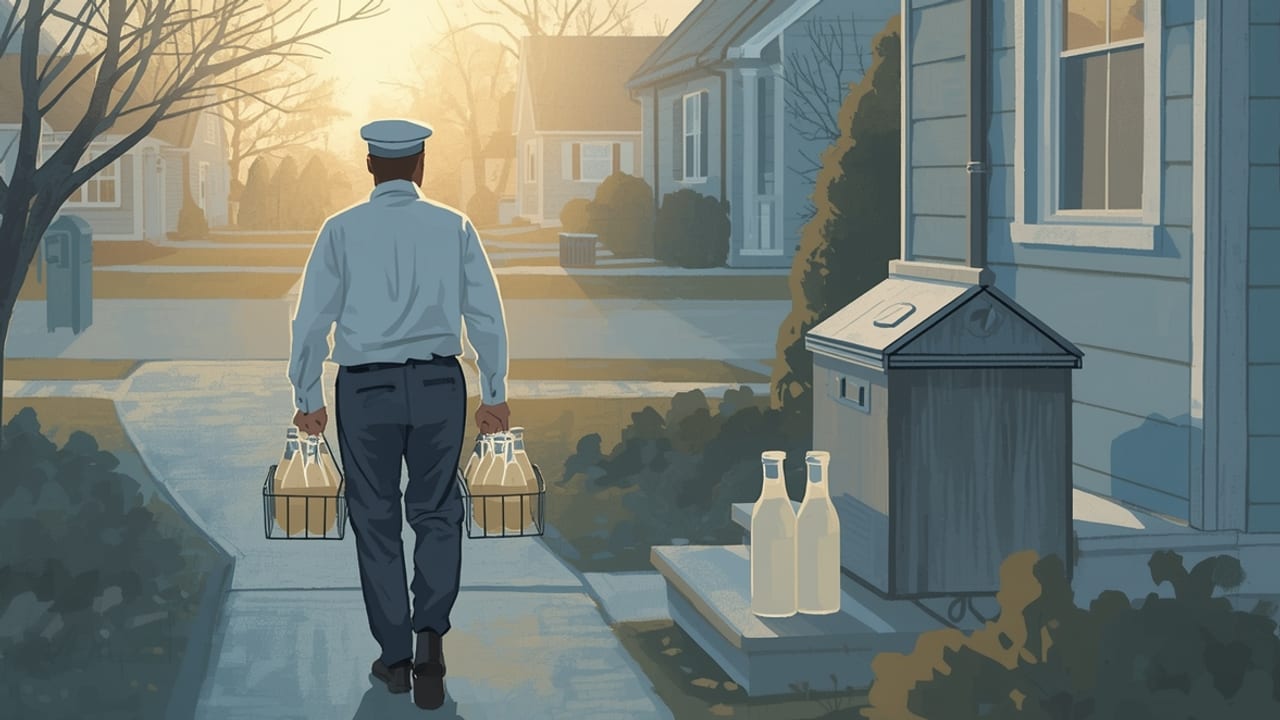
There was a sound that came before the birds. If you grew up in the 1950s or 60s, you may still hear it when you wake too early: the soft clink of glass on a back step, footsteps on the walk, and a truck humming patiently at the curb while the whole street slept.
The milkman came while you were dreaming, and somehow breakfast was always ready for you.
Before the Sun Came Up
He started in the dark. In summer the sky might be turning pearl gray by the time he reached your block, and in winter he worked under streetlights and porch bulbs, his breath going up in little clouds.
You rarely saw him on a school day. You only knew he had been there because the bottles were waiting, cold and beaded with dew, when your mother opened the back door to let the cat out.
On Saturdays it was different. If you were up early enough, you could press your nose to the kitchen window and watch him come up the drive, a wire carrier swinging from one hand, bottles chiming against each other like a quiet set of bells.
The Box on the Back Step
Many houses had a milk box. It might be galvanized metal, dented from years of use, or a sturdier insulated box with a lid that latched. Some had the dairy’s name stamped on the front, and they stood by the back door so faithfully you hardly noticed them.
In some homes there was something even better: a little milk door built right into the wall, with a hatch on the outside and another on the inside. The milkman set the bottles in, and your mother took them out without ever stepping into the cold. More than one child in those days was small enough to wriggle through when the family got locked out, and plenty of families were glad of it.
The Note in the Empty Bottle
This was how you placed your order. Your mother tore a scrap from the grocery pad, wrote it out in pencil, rolled it up and tucked it into the neck of a rinsed bottle.
“Two quarts milk. One pint cream. Cottage cheese, please.”
If company was coming, the note grew longer. If the family was going to Grandma’s for the week, it said simply, “None until Monday.” Some dairies gave out little cardboard dials or flags you could turn to show what you wanted, but the rolled note was the old reliable.
Everyone knew the rule. You rinsed the empties before you set them out. Sending back a bottle with soured milk in the bottom was a small household shame, and children were taught early to run water through them at the sink.
In many Canadian towns, families bought milk tickets ahead of time and left them in the bottle instead of cash. In plenty of American neighborhoods, the money went into an envelope under the bottle on collection day, and nobody thought twice about leaving it there.
Cream on Top
Before homogenized milk took over, the cream rose. You could see it through the glass, a thick golden band sitting above the white, and in many houses it was a quiet contest to see who got to it first.
Some mothers poured it off for coffee or for strawberries on Sunday. Some shook the bottle hard to mix it back in. And some children learned to sneak a spoonful straight from the top before anyone else came down.
The bottles themselves were lovely things, heavy in the hand, sometimes with the dairy’s name pressed or painted on the side. The caps were round pieces of cardboard that fit snug in the neck, and later came caps with little pull tabs. There was always a knack to popping one out with your thumb without splashing milk down your shirt.
And the flavors felt like luxuries: chocolate milk for a birthday, buttermilk for your father, who swore it was good for him, eggs and butter and orange juice once the dairies started carrying more.
January Mornings
If you lived anywhere with a real winter, you remember this. On the coldest mornings, the milk froze in the bottle and pushed the cap right up, so a little column of frozen cream stood above the glass like a white hat.
Your mother would bring it in and set it by the stove to soften. Children thought it was the funniest thing in the world. Some of them, if they were quick, broke off a piece and ate it like ice cream before breakfast.
The milkman kept coming through it all. Snow, sleet, the deep cold that made the car groan. He came anyway.
The Truck That Hummed
In the earliest years some towns still had horse-drawn milk wagons, and older folks will tell you the horse knew the route better than the driver. It would stop at each house on its own and wait.
By the 50s, most milkmen drove the boxy white trucks so many of us remember. A great many of them were Divcos, with that rounded nose and the sliding doors left open in warm weather. The milkman often drove standing up, which seemed to every child like the most wonderful job in America.
Inside it smelled of cold metal and wet cardboard. On a hot summer day, if you were lucky and he was kind, he might hand you a chip of ice from the back to suck on while you walked home.
Others Who Came Calling
The milkman wasn’t the only one. In many towns, a bread man came by with loaves still faintly warm, and sweet rolls if you could talk your mother into them.
The paperboy pedaled past at dawn and came knocking on Saturday to collect. The Avon lady rang the bell with her case of little lipstick samples. The Fuller Brush man stood on the porch and showed off a vegetable brush as if it were fine jewelry.
In some parts of the country, Charles Chips came right to the door in big tins. Out in the Midwest and beyond, the Schwan’s truck brought ice cream to farmhouses miles from any store. The doctor still made house calls in some places, and the dry cleaner brought your father’s suit back on a hanger.
The world came to your door in those days, and it knocked politely.
What It Quietly Meant
The milkman knew your family. He knew when a new baby arrived, because the order suddenly doubled. He knew when the house had gone quiet, when the children had grown and the note asked for just one quart now.
He knew which dog barked and which one only wanted a pat. He knew to set the bottles in the shade at the house where the widow lived alone, and some milkmen noticed when yesterday’s bottles hadn’t been taken in, and knocked to make sure everything was all right.
There was a trust in it that is hard to describe to anyone who wasn’t there. A back door left unlocked. Money left in plain sight. A stranger who wasn’t really a stranger, walking up your drive while you slept, bringing exactly what you asked for.
It was a small thing, a quart of milk. But it arrived every morning, faithful as the sunrise, and it told a child that somebody out there was looking after the house before anyone was awake.
So the next time you lift a plastic jug from the grocery cooler, let yourself hear it for just a moment: the clink of glass on the back step, and the hum of a truck at the curb, moving on down the sleeping street.
Reading this aloud?
- Good for
- A senior-center reminiscence hour, a church fellowship breakfast or a family gathering with grandparents
- Time
- About 9 minutes read aloud
- Fits a lesson on
- nostalgia, trust and neighborliness, faithfulness, growing older
Tip: Read the frozen cream "like a white hat" with a smile and pause for laughter, then slow down through "What It Quietly Meant," letting the final clink of glass and humming truck linger.
Questions to talk about
- What sounds or deliveries from your childhood mornings do you still remember?
- Who in your life has quietly looked after you the way this milkman looked after his route?
- How has the way neighbors trust each other changed since you were young, and what would you like to bring back?
- What small, faithful things do you do for others that they might never see?
Lead a group every week? Get the free large-print Read-Aloud Pack, four stories with questions and memory care prompts, ready to print.
From inspire21.com/remember-when-the-milkman-came-to-the-back-door/
More like this in Remember When.
Did this story lift you up?
Share it with someone
Up next
My Teacher's Simple Three-Word Phrase
By Stephen J. Hopson My life was dramatically transformed because a simple three word phrase was delivered at the right time in just the right way. When I…