My mother set one plate at Thanksgiving that never matched the others.
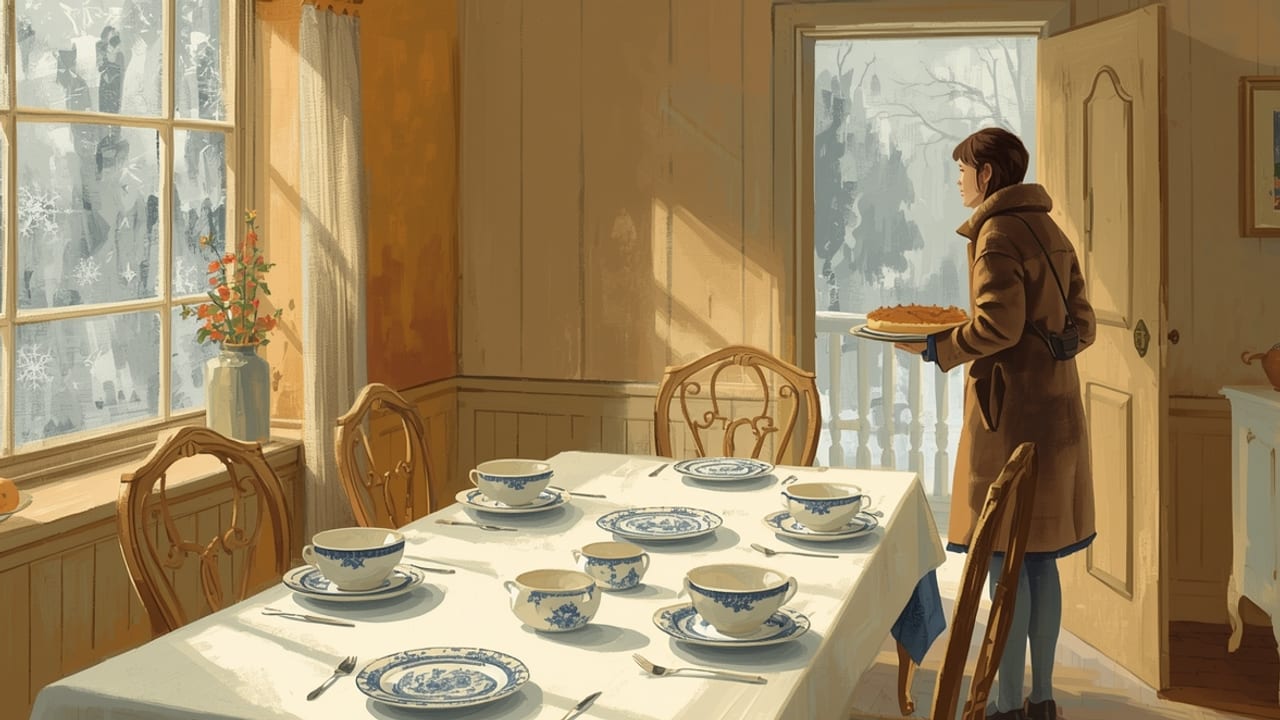
The good china was cream with a thin gold rim, a wedding gift from 1958 that came out twice a year and was washed by hand, never by machine. The odd plate was blue willow, with a chip on the edge shaped like a fingernail moon.
She put it at the end of the table nearest the kitchen door. A folded napkin, the second-best fork, and the chair pulled out just a little, as if somebody had stood up to fetch the gravy.
“For whoever the Lord sends,” she’d say, if anyone asked. Mostly nobody asked. We grew up with that plate the way you grow up with a creaky stair.
Some years the Lord sent nobody, and the chair held coats, or the cat. Some years He sent somebody.
This was the first Thanksgiving without Mama. She passed in March at County Memorial in Hollis Bend, eighty-nine years old and still giving the night staff advice about their love lives.
So the turkey was mine now, and the house on Sorrel Street was mine, and so was the question my husband asked while I stood at the china cabinet with the blue plate in my hands.
“You setting it, Marian?”
I didn’t answer right away. It felt like pretending. It felt like setting a place for her.
My brother Lloyd came through the back door stamping sleet off his boots, took one look at me, and said, “Set it. She’ll haunt us if you don’t. She’ll rattle the gravy boat.”
So I set it.
We were eleven at the table. Dennis and me, Lloyd and his wife Carol, our son Kyle and his family, and Carol’s sister, who brings the same green bean casserole every year and is right to.
Lloyd tried to say Mama’s grace. He got through “Bless this food and the hands that made it” before his voice went thin. Our granddaughter Molly, who is nine, finished it for him without being asked.
“And the feet that brought us here. Amen.”
She’d learned it at this table. I hadn’t known she was listening.
It was Ben, her little brother, who pointed at the blue plate with a roll in his fist. “Who’s that for?”
I went to the hall closet and came back with the tin.
It was a round cookie tin that once held shortbread, dented on one side from a long-ago move. Inside was a stack of instant photographs, the square kind with the white border. On the back of each one, in Mama’s slanting pencil, was a year and a name.
Taped inside the lid was an index card in the same hand: “Be not forgetful to entertain strangers: for thereby some have entertained angels unawares.” Hebrews 13:2.
We passed them around between the sweet potatoes and the cranberry sauce.
-
A skinny young man in an Army jacket, grinning over a drumstick. “Dale, hitching to basic training. Ate three helpings.”
-
A tired woman and two boys with cowlicks. “Mrs. Pruitt, flat tire on Route 9. Lloyd changed it.”
“I did,” Lloyd said, surprised. “I forgot that. I was fifteen. I put the spare on backwards the first time.”
-
A man in a feed cap holding his plate up for the camera. “Mr. Abernathy, new in town from Georgia. Brought peaches in November, bless him.”
-
A girl about Molly’s age, very serious, picking at her plate. “Rosalind, with the Hendersons for the winter. Would not eat the stuffing because it had celery. Ate four rolls instead.”
Molly leaned over to look. “I don’t like celery either,” she said, with deep approval.
There were blank years too, years with no photograph at all. Mama never seemed bothered by those. She set the plate anyway, the way you leave a porch light on.
“Did any of them ever come back?” Ben asked.
“Not that I know of,” I said. “She never needed them to.”
That was when the doorbell rang.
The young woman on the porch had sleet in her hair and a pumpkin pie from the grocery store, the price sticker still on the plastic lid. Under her puffy coat I could see hospital scrubs, the soft blue kind.
“I’m so sorry,” she said. “I might have the wrong house. Is this Opal’s house?”
I must have nodded.
“I’m Tessa. I worked nights on the fourth floor. In March.” She held the pie a little higher, as if it were a ticket. “She couldn’t sleep, so we’d talk. She asked me where I’d be for Thanksgiving, and I said working, probably, or sleeping. My people are all out in Oregon.”
She swallowed.
“She said, ‘Then you’ll eat with us. Fourth Thursday, one o’clock, Sorrel Street. There’ll be a blue plate.’ She made me write it on my hand. Then I went off shift, and when I came back…”
She didn’t finish.
“I didn’t know if it still counted,” she said. “I got off at seven this morning. I almost turned around twice.”
I thought of the last week in March. Of Mama, half-asleep, gripping my wrist and saying, “Don’t forget the plate, Marian.” I’d patted her hand and told her Thanksgiving was months away. I thought she was confused.
She wasn’t confused. She was making arrangements.
“It counts,” I said, and took the pie, and took her coat.
Molly lifted the cat off the chair without being told. Kyle’s wife fixed a plate. Lloyd passed the rolls with both hands like he was handing over something precious, which I suppose he was.
Tessa sat down at the blue plate and touched the little chip on the edge with one finger.
“She told me about this,” she said. “The moon on the rim. She said I’d know it was mine.”
She ate two helpings of everything and told us things about Mama we’d never heard. How she’d quizzed the respiratory therapist on his Sunday school attendance. How she’d hummed “Come, Ye Thankful People, Come” at three in the morning, in March, because she said it was never too early to practice.
We ate Tessa’s grocery-store pie. It was too sweet.
When the dishes were stacked, Lloyd went out to his truck and came back with Mama’s old instant camera. He’d found film for it at an estate sale in October and hadn’t told anyone why.
“Everybody stay put,” he said.
Tessa laughed and held up her fork. The flash went off, and the square of film slid out gray and blank and slowly filled with her face.
I found a pencil in the junk drawer, the same drawer Mama had kept it in for fifty years. I turned the photograph over on the tablecloth and wrote in my own hand, underneath where hers would have been:
“This year. Tessa, from the fourth floor. Mama sent her.”
Then I laid it in the tin, right on top, and pressed the lid down until it clicked.
From inspire21.com/the-blue-plate-at-the-end-of-the-table/
More like this in Thanksgiving Stories.
Did this story lift you up?
Share it with someone
Up next

Christmas Wish
It was Christmas Eve and the Lord looked down from above at all His children. It had been nearly two thousand years since the birth of His Son and turning…