Carol drove out to the house for three things: her father’s reading glasses, his blue flannel robe, and the slippers with the split heel that her mother kept threatening to throw away.
She found all three. Then she found the notebooks.
They were in the drawer of his nightstand, under a pocket New Testament and a roll of peppermints. Seven of them, the cheap spiral kind, held together with a rubber band from the morning paper.
She assumed they were fishing logs. Harlan Pruett wrote everything down. The rainfall in Cedar Hollow, the day the robins came back, the mileage on the truck, how many crappie he pulled out of Bitter Lake and what he was using when he did. So she opened the top one expecting bait and weather.
Inside the front cover, in his square carpenter’s printing, it said: Things Dot does. So I don’t miss them.
She sat down on the edge of the bed.
April 9. Dot hummed “Blessed Assurance” while she did the dishes. Two verses. She always forgets the third.
April 10. She put the good towel on my side of the rack.
April 11. Called her sister in Tulsa and laughed so hard she had to sit down on the stairs.
The first notebook began the spring he retired from the feed mill, eleven years ago. The last one was half full. Carol put the rubber band back on, set the stack in the bag on top of the robe, and drove the forty minutes back to Merriwether Regional without turning on the radio.
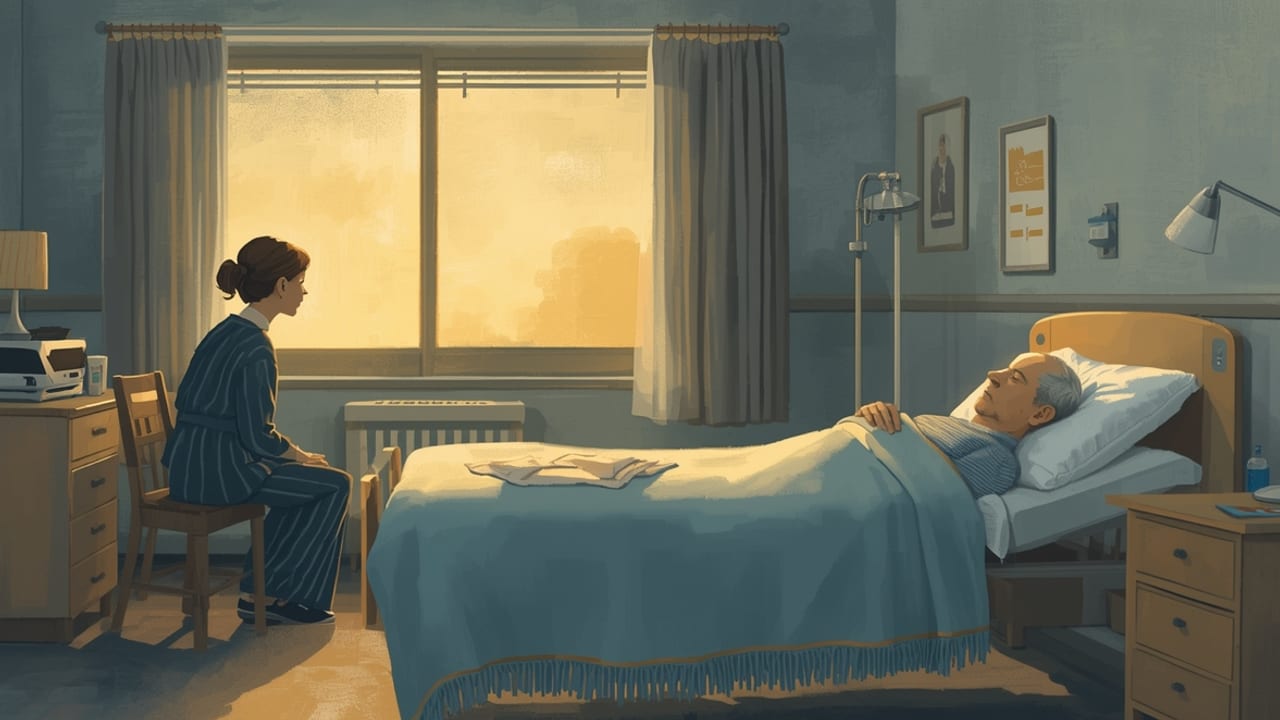
Her mother had been in the vinyl chair beside the bed for three days. She had eaten half a turkey sandwich in that time and refused the cot the nurses kept offering. Dot Pruett was seventy-four years old and did not believe in cots.
Dad lay with his head turned a little toward the window. The stroke had taken most of his left side and nearly all of his words. Sometimes his eyes opened and moved around the room. Sometimes they found Mom and stayed there.
“You got the robe,” Mom said. “Good. Those hospital gowns are an insult.”
“I got something else too.” Carol pulled the second chair close and took out the notebooks. “These were in his nightstand.”
Mom looked at them over her glasses. “Fish.”
“Not fish.”
Carol opened the first one and read the inside cover out loud. Her mother didn’t say anything. So Carol turned the page and kept going.
“May 3. She ate the burnt pancake and gave me the good one. Said she likes them crispy. She does not.”
“I do so,” Mom said. Then, after a moment: “I don’t.”
“May 19. Drove Mrs. Kettering to her eye appointment in the rain. Came home and didn’t mention it. I only know because Mrs. Kettering called to thank her and I answered.”
“June 30. Dot cut the crusts off my sandwich. I have not asked for that since 1971.”
Mom laughed, a short surprised sound, and put her hand flat over her mouth. “He had a sore tooth,” she said through her fingers. “In 1971. For about a week.”
Carol read on. The entries were small, almost nothing. A pie carried to a neighbor whose husband was in the hospital. A grandchild’s drawing taped inside a kitchen cabinet so it wouldn’t fade in the sun. Mom singing alto at the little church on Spurlock Road with her eyes closed. Mom leaving the porch light on for the paper boy in winter.
“October 14. She drove out to the church to set up for the Hendersons’ funeral dinner and came home with mud to her knees. Didn’t complain. I would have.”
“January 20. She stood at the kitchen window a long time watching the cardinal at the feeder. I watched her watching it. Best part of my day.”
Carol had to stop there. She looked up and her mother was leaning over the bed, holding Dad’s right hand in both of hers.
His eyes were open. They were on Mom.
“You’ve been spying on me, Harlan Pruett,” she told him softly. “Eleven years.”
His fingers moved against hers. It wasn’t much. But Carol saw it, and she saw her mother feel it.
“Keep reading,” Mom said, without looking away from him.
So Carol turned to the last notebook, to a page with a date she knew by heart, because she had baked the cake.
“August 22. Our anniversary. Fifty years. She wore the blue earrings I gave her when Carol was born. I sat down to write tonight and couldn’t think where to start, there’s too much. Fifty years of her, and I only started paying proper attention eleven years ago. Lord, give me enough time left to catch up.”
The room was quiet except for the soft beep of the monitor and a food cart rattling somewhere down the hall. Outside the window, the March light was going thin and gold over the parking lot.
Mom rested her forehead against the back of Dad’s hand. She stayed like that for a long while.
Carol turned a few more pages, to the last entry he had written. The handwriting was the same as always, steady and square.
“March 2. She let me win at gin rummy. Third night running. She thinks I don’t know.”
After that, the pages were blank.
“He knew,” Mom said. Her shoulders shook once, and she pressed the back of her wrist hard against her nose. “Of course he knew. He always counts the discards.”
She sat back and wiped her eyes with the heel of her hand. Then she held out her palm.
“Have you got a pen?”
Carol dug one out of her purse, a ballpoint from the bank with half the ink gone. Mom took the notebook from her lap and opened it to the first empty page. She smoothed it with her fingers the way she used to smooth Carol’s hair before church.
She wrote slowly, reading the words aloud as she went, so he could hear them.
“March 6. Harlan squeezed my hand when Carol read the part about the cardinal. He’s still watching me. I’m watching him back.”
She clicked the pen and tucked it into the spiral. Then she set the notebook on the blanket by his good hand, where he could reach it, and went back to holding on.
Reading this aloud?
- Good for
- A Valentine's or anniversary service, a marriage small group or a senior-center reading hour
- Time
- About 8 minutes read aloud
- Fits a lesson on
- noticing love, faithful marriage, gratitude for small kindnesses, caring through illness
Tip: Read the notebook entries in a slightly slower, gentler voice than the narration, and pause after the cardinal entry and again after "After that, the pages were blank" before Dot speaks.
Questions to talk about
- Which of Harlan's notebook entries stayed with you most, and why?
- Harlan wrote that he only started paying proper attention eleven years ago. What small things do the people closest to you do that are easy to overlook?
- Why do you think Dot chose to write her own entry in the notebook at the end?
- What could you do this week to let someone know you have noticed the quiet ways they care for you?
Lead a group every week? Get the free large-print Read-Aloud Pack, four stories with questions and memory care prompts, ready to print.
From inspire21.com/the-notebooks-in-dads-nightstand/
Did this story lift you up?
Share it with someone
Up next

Make love a part of your life
Once upon a time all feelings and emotions went to a coastal island for a vacation. According to their nature, each was having a good time. Suddenly, a…