My grandmother’s Christmas tablecloth weighs nearly as much as a winter coat. It is white linen gone the color of weak tea, and it is covered, edge to edge, in names.
The rule started in 1961, the first Christmas Rosalind Haverkamp hosted in the farmhouse outside Linden Falls, Wisconsin. After the pie, everyone at the table signed the cloth in pencil. In January, when the house was quiet and the snow piled against the kitchen door, Grandma Roz stitched over every name in red or green thread, so it would be waiting under the platters the next year.
Sixty-four Christmases of names. Uncles I never met. My mother at six, her S backwards. An exchange student from 1979 who wrote “Thank you for the ham.” The pastor who came in 1988 because his furnace quit. My own name, enormous and lopsided, from the year I was five and pressed so hard the pencil tore a tiny hole she mended with a French knot.
Only one place on the cloth had never been written in. It sat near the center, a bare patch about the size of a saucer, just left of the old gravy stain. Whenever anyone reached for it, Grandma laid her hand flat over it.
“That’s saved,” she’d say.
“For who?”
And she’d recite Luke, the way she did every Christmas Eve before grace: “And she brought forth her firstborn son, and wrapped him in swaddling clothes, and laid him in a manger; because there was no room for them in the inn.” Then she’d tap the bare linen. “There’s always room at this table. I just don’t know yet who it’s for.”
Last January, for the first time, the names didn’t get stitched.
Grandma was ninety-one. Her hands had begun to tremble like leaves in late October, and her eyes had dimmed to light and shadow. She tried. In the fall I found her needle still threaded, stuck in the cloth beside my cousin Mitch’s name, three red stitches into the M.
“You do them,” she said, when I came for Sunday dinner the first week of December. She pushed the folded cloth across the table. “You’ve got young eyes.”
I told her the truth. I could not sew a button. I was thirty-six years old and had spent five years in waiting rooms, and I had nothing left over for embroidery.
I did not tell her the rest. That Danny and I had stopped talking about it. That we had quietly given back the crib his brother lent us. That I’d almost asked if we could skip Christmas this year, just stay home and eat soup and not answer anyone’s kind questions.
Grandma only patted the cloth. “Fourteen names,” she said. “You’ve got till Christmas Eve.”
So I learned. Mrs. Odegaard from the quilting circle at Prairie Chapel showed me a backstitch in the fellowship hall, her reading glasses swinging on a beaded chain. I practiced on a dish towel until my stitches stopped looking like barbed wire.
Then, every night after supper, I sat in the corner of our couch with the tablecloth over my knees and worked one name at a time.
It is a strange thing, to stitch a person. You go slowly. You follow every loop of their handwriting, every place they pressed hard or trailed off. You find out that Uncle Pete still crosses his sevens. You notice that Aunt Lorraine, who lost her husband in March, signed in a hand so small it hardly left a mark.
Danny started sitting beside me. He held the lamp closer when I worked the tiny letters. He read the old names out loud, the ones already in thread, and asked who they were. I told him what I knew and made up what I didn’t, and some nights we laughed until the dog left the room.
Somewhere in the second week, I stopped counting days the way I’d been counting them for five years.
Somewhere in the third week, I was late.
I took the test on a Tuesday morning and sat on the edge of the bathtub holding it until the window turned from gray to gold. I didn’t tell Danny. I didn’t tell anyone. I’d been here before, twice, and both times the hope had drained out of me like water through a cracked cup. I put the test in my coat pocket and went to work, and that night I stitched Aunt Lorraine’s name in green, very carefully, and said nothing at all.
On Christmas Eve the farmhouse smelled of ham and cloves and the coffee Grandma still insisted on making in her dented percolator. Twenty-two of us crowded around two tables pushed end to end. The cloth lay over all of it, the new stitches bright among the faded ones.
Grandma ran her trembling fingers along the edge until she found them. She couldn’t see the names, but she could feel them. “Good,” she said. That was all, and it was enough.
She said the verse from Luke. We prayed. We ate until Mitch’s youngest fell asleep under the table.
After the pie, the pencils came out, the same as every year. The cloth went around. Danny signed in his tidy engineer’s printing. I signed below him, and my hand shook almost as much as hers.
Then Grandma did something she had never done.
She reached across the table, found my wrist, and guided it to the bare place near the center. She pressed the pencil into my palm.
“Not me, Grandma,” I said. “That’s saved.”
“I know it is.” Her clouded eyes rested somewhere just past my shoulder, but she was smiling. “I saved it sixty-four years. Never felt right to fill it. This morning I woke up and it felt full.” She folded my fingers around the pencil. “Write whoever’s coming.”
The table went quiet. My mother set down her fork.
I have asked Grandma since how she knew. She only shrugs and says the Lord keeps His own calendar, and all she ever did was set the table.
I looked at Danny. He looked at the pencil, and then at me, and I watched him understand before I said a word.
I wrote it small in the bare linen, pressing gently so it wouldn’t tear.
Baby Lindahl. Coming in August.
Nobody spoke for a long moment. Then Aunt Lorraine began to laugh, a soft, surprised sound with tears in it, and my mother came around the table, and Danny put his face in my hair. Under the table, Mitch’s youngest woke up and asked if it was time for presents.
Grandma sat very still with her hand resting on the place where I’d written, as if she could feel the letters through the cloth.
“Well,” she said. “There’s room.”
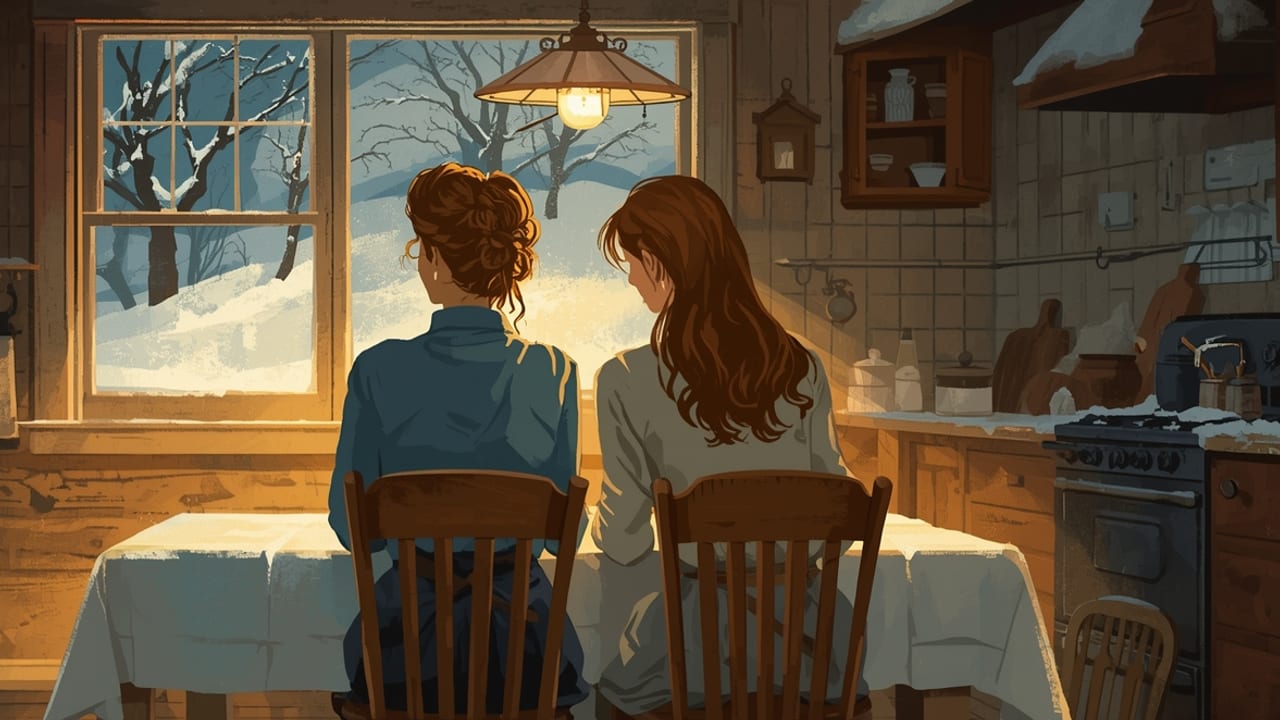
I stitched it in January, in the farmhouse kitchen with snow against the door and Grandma beside me, listening to the thread pull through.
I used both colors, red and green, twisted together into one strand. She told me it was a waste of good thread, and she told me smiling.
Reading this aloud?
- Good for
- A Christmas Eve service, an Advent small group or a family reading after Christmas dinner
- Time
- About 9 minutes read aloud
- Fits a lesson on
- hope after waiting, family traditions, room at the table, God's timing
Tip: Slow down when Grandma presses the pencil into her granddaughter's palm, pause after "Write whoever's coming," then read "Baby Lindahl. Coming in August" softly before letting the room breathe.
Questions to talk about
- Why do you think Grandma Roz kept one place on the tablecloth empty for so many years?
- How did stitching other people's names change the narrator and Danny during a hard season?
- What family tradition helps your family remember the people who have gathered with you over the years?
- When have you had to wait a long time for something, and what helped you keep going?
Lead a group every week? Get the free large-print Read-Aloud Pack, four stories with questions and memory care prompts, ready to print.
From inspire21.com/the-christmas-tablecloth-with-one-place-saved/
More like this in Christmas stories.
Did this story lift you up?
Share it with someone
Up next

Easter Story
A holy man sees two identical rooms with long-handled spoons, one Heaven and one Hell, and learns what makes the difference. Includes the poem On the Third Day.