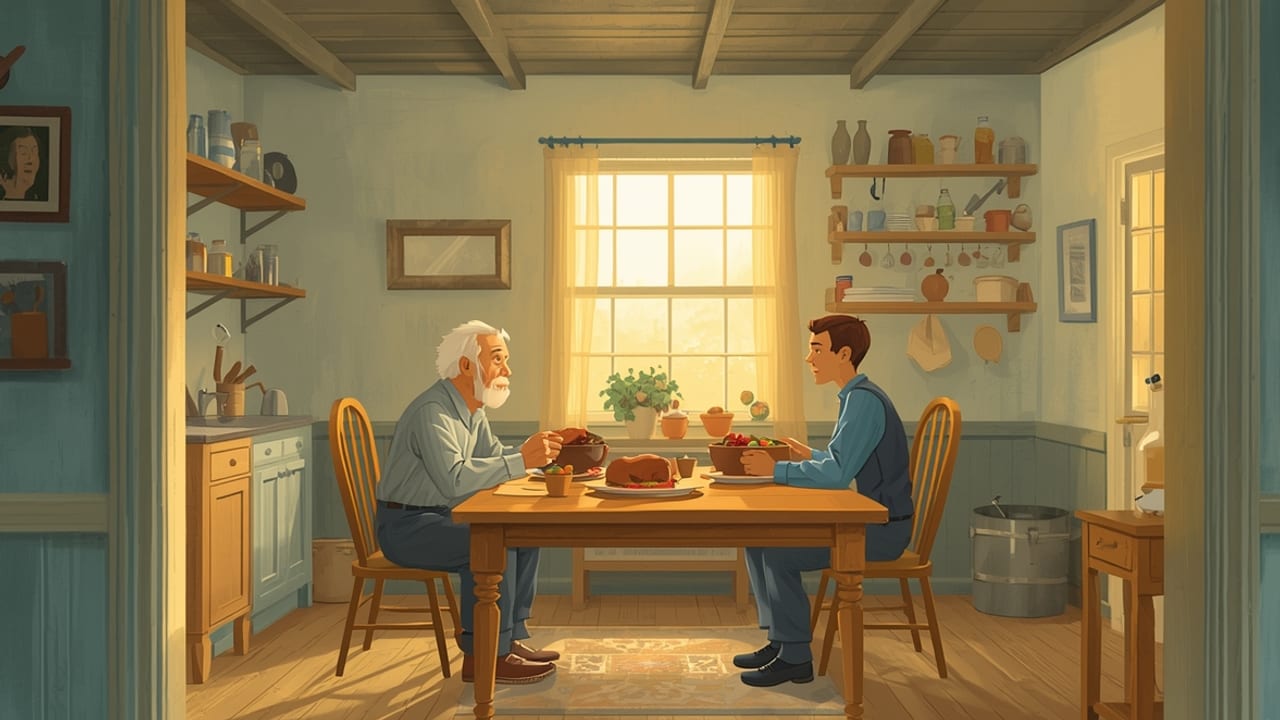
Lloyd Pruett had peeled one more potato than he needed every Saturday night for twenty-six months, and every Monday he fed the leftover to the barn cats.
The habit belonged to his wife. For forty-one years of marriage, through drought years and good wheat years, Dot had dropped an extra potato into the pot on Saturday night. She called it the stranger’s potato. On Sunday she’d lay her grandmother’s linen napkin, the one with a blue sparrow cross-stitched in the corner, at the chair across from Lloyd.
Over time that napkin had been used by the boys from the grain elevator, a new pastor, and once a lost insurance salesman with a flat tire.
“For whoever God sends,” Dot would say, smoothing the sparrow flat. Most Sundays God sent nobody, and she didn’t seem to mind. On Monday morning she’d fold the napkin back into the drawer, unused, like a prayer she was glad to have said anyway.
After the funeral, Lloyd’s sister in Salina told him he ought to sell the place and come live near her. His knee told him the same thing every morning on the stairs. The neighbor, Harley Voss, had made a fair offer on the north quarter and an even fairer one on the rest.
Lloyd hadn’t answered anybody. He just kept peeling the extra potato.
The last Sunday in May, the rain was coming sideways when he walked out of Ransom Flats Community Church. He drove home with the wipers on full. Three miles short of his lane he saw a shape on the shoulder of the highway, hunched under a backpack, thumb out without much hope in it.
Lloyd had not picked up a hitchhiker since 1974. He pulled over anyway.
The boy who climbed in was nineteen, maybe twenty, soaked through his gray sweatshirt. He said his name was Travis and he was headed to Denver, where a fellow had promised him a job framing houses. He said it the way people say things they’ve stopped believing.
“You eaten?” Lloyd asked.
“Yes sir. Yesterday.”
Lloyd turned into his lane without discussing it further.
The pot roast had been in the oven since seven that morning, with carrots and onions and the little red potatoes Dot always insisted on. Lloyd had burned his first eleven attempts at that roast the winter after she died. He’d gotten it right on the twelfth, alone in the kitchen with her recipe card propped against the sugar canister, and had nearly cried, which seemed a foolish thing to do over beef.
Travis stood in the doorway dripping on the rug.
“Bathroom’s down the hall,” Lloyd said. “There’s a flannel shirt on the hook that’ll swallow you, but it’s dry.”
When the boy came back, Lloyd had the sparrow napkin out of the drawer and laid beside the second plate.
Travis looked at it, and at the glass of iced tea already sweating on the oilcloth. “You expecting somebody?”
“Was,” Lloyd said. “Sit down.”
Travis ate like he was trying not to. Lloyd passed him the roast twice and the rolls three times and pretended not to notice when one went into the flannel shirt pocket. Rain rattled the gutters. The clock over the stove, which Dot had bought at a church auction and kept four minutes fast on purpose, ticked through grace and the first helping and the second.
When Travis reached for the last potato, Lloyd nodded at it.
“That one’s yours,” he said. “My wife always cooked one extra. For whoever God sends. She had a verse she liked.”
He tipped his head toward the windowsill, where a card in Dot’s handwriting had faded to the color of weak tea. “Be not forgetful to entertain strangers: for thereby some have entertained angels unawares. Hebrews 13:2.”
Travis set down his fork. “I’m not any angel, sir. I ought to tell you that.”
“Didn’t figure you were,” Lloyd said. “Pass the beans.”
The rain held through Monday. On Tuesday the road to Denver was dry, and Travis stood on the porch with his pack and said he’d be going.
Lloyd was sitting on the bottom step, trying to work a seized bolt off the swather blade. His knee was turning it into a two-man job.
“Hand me that wrench before you go,” he said.
Travis handed it to him. Then he held the blade steady. Then he asked what a swather was, and Lloyd showed him, and by supper the bolt was off and the pack was back inside by the door.
He stayed through wheat harvest. He was terrible at first. He drove the grain truck like it owed him money and once backed it halfway into the stock tank. But he was up before Lloyd every morning, and he listened. By the end of June he could hear the sound a combine makes just before something goes wrong, which is the sound nobody can teach.
In the evenings, pieces of him came out on the porch. A mother who’d left. A string of foster homes in Wichita. An aunt in Topeka who’d let him sleep on the couch until her boyfriend didn’t.
Lloyd didn’t say much back. He had learned from Dot that the best thing to do with a hard story is to sit still and let it be told.
In July, Travis started riding along to church. He sat at the end of the pew and didn’t sing. Then one Sunday Lloyd heard him humming “Leaning on the Everlasting Arms” under his breath, a half beat behind.
Lloyd called Harley Voss in August.
“I’m not selling this year,” he said.
“Your knee get better?”
“No,” Lloyd said. “I got a hired man.”
Harley was quiet a moment. “That Denver kid? Lloyd, you don’t know a thing about him.”
“I know he gets up at five,” Lloyd said. “I know he hums.”
It’s been three years now. Travis has a room upstairs with a quilt Dot’s sewing circle pieced. He has a degree in agricultural mechanics from the community college two counties over, and opinions about soil moisture that he shares more often than anybody asks.
Lloyd’s knee is no better. He doesn’t climb the grain bins anymore. He doesn’t need to.
On Sundays Travis cooks. His roast is better than Lloyd’s, though neither of them will say so out loud, and he adds garlic, which Dot would have called showing off.
Last Saturday night, Lloyd came in from the porch and found Travis at the sink with the paring knife and a bowl of red potatoes.
Lloyd counted them. Then he counted them again. There were enough for two hungry men, and one more.
In the drawer, the sparrow napkin had already been ironed and folded on top.
Lloyd stood looking at it a long moment.
“You expecting somebody?” he asked.
Travis didn’t look up from the potato in his hand. “Always,” he said.
Reading this aloud?
- Good for
- A sermon on hospitality, a Sunday school class or a senior group story hour
- Time
- About 8 minutes read aloud
- Fits a lesson on
- hospitality, grief and carrying on, second chances, welcoming strangers
Tip: Slow down for Lloyd's "Was," then pause after he counts the potatoes twice at the end, and let Travis's final "Always" land quietly before looking up.
Questions to talk about
- Why do you think Lloyd kept peeling the extra potato after Dot died?
- What changed for Lloyd once Travis stayed, and what changed for Travis?
- Who has set a place for you when you needed it, and what did that mean to you?
- What small habit of welcome could you carry on in your own home or church?
Lead a group every week? Get the free large-print Read-Aloud Pack, four stories with questions and memory care prompts, ready to print.
From inspire21.com/the-hitchhiker-who-came-to-sunday-dinner/
Did this story lift you up?
Share it with someone
Up next
He Is God
I received this inspirational prayer poem from a dear friend and knew instantly it was destined for "Inspiring Stories." Pete Barkelew Editor He is the…