Arlo Pruitt lost most of his words on a Tuesday in October, somewhere between the back porch and the truck.
He had gone out to check the tire pressure before driving to the co-op. Bernice found him sitting on the bottom step with the gauge still in his hand, looking at it like it belonged to someone else. When she said his name, he opened his mouth and nothing came out that she could use.
By Thanksgiving week he was on the third floor of the rehabilitation wing at Harlan Springs, forty minutes from their house in Ottery, Kansas. He could stand with the walker if someone held the belt around his waist. He could eat soft food with his left hand. He could say “yes” and sometimes “no,” though he mixed them up when he was tired.
And he could say “thank you.” Perfectly. Every time.
The speech therapist, a brisk young woman named Kendra with a swinging ponytail and a lanyard full of keys, said it happened that way sometimes. “Words we’ve used ten thousand times get worn into a different path,” she told Bernice. “Prayers. Old songs. Manners. They can come through when other things can’t.”
Bernice nodded like that made sense. It did not make sense to her at all.
Forty-six years married, and he could not say her name. He could not say “Bea,” which is what he had called her since the night they met at the Grange hall. He could not say “I love you” or “Where’s the remote” or “Did you call Henderson about the hay.”
But when the aide brought a pudding cup, he looked her right in the eye and said, “Thank you,” clear as a church bell.
He said it to the man who emptied the trash. He said it to the night nurse who checked on him at two in the morning. He said it to the chaplain, to the girl who delivered the menus, to the physical therapist who made him walk until his shirt was damp.
Bernice started to hate the sound of it.
She was ashamed of that. She told no one. But on the drive home each night, past the dark wheat stubble and the lit-up elevator at Doyle Junction, she would grip the wheel and think, He’s giving them all away. Every good word he has left, he’s handing to strangers.
On the Sunday before Thanksgiving she did not go to church. She told herself it was because she had laundry, which was true, and because she was tired, which was truer.
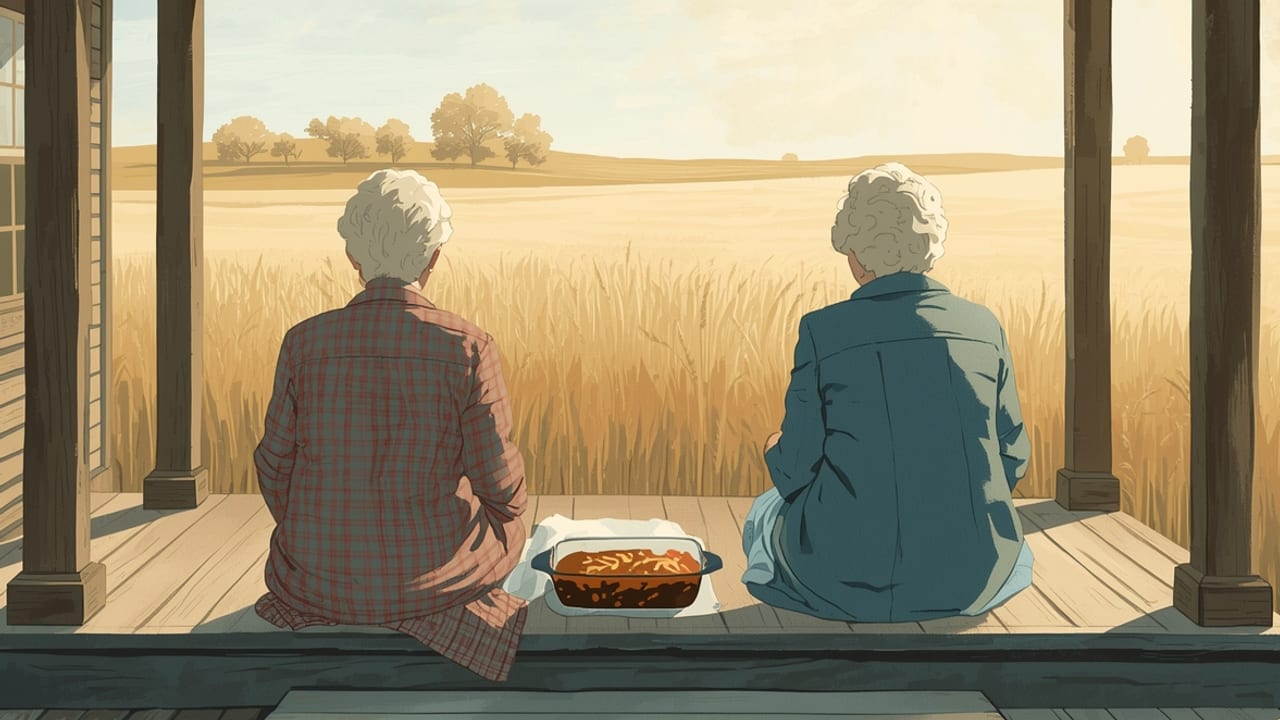
At one o’clock Opal Fenwick pulled into the drive in her old blue sedan with a chicken-and-noodle casserole on the passenger seat, wrapped in a bath towel to keep it warm. Opal had played the piano at Ottery Community Church for thirty-one years and had never once, in Bernice’s memory, waited to be invited anywhere.
They sat on the back porch steps because the kitchen felt too big. The November sun was thin, but it was out. Opal had brought two forks.
“Pastor Dunning asked about you,” Opal said. “So did the whole alto section.”
“I’m sorry I wasn’t there.”
“Nobody’s keeping score, honey.”
Bernice pushed a noodle around. Then she said the thing she hadn’t said to anybody. She told Opal about the pudding cup, and the trash man, and the night nurse. She told her how she sat in that vinyl chair by the window every afternoon, waiting for him to look at her and say something, anything, that was hers.
“He thanks the girl who brings the menus,” she said. “And then he looks at me like I’m part of the furniture.”
Opal didn’t answer right away. She set her fork down on the towel.
“You remember the Thanksgiving the elevator burned?” she said.
Bernice did. Arlo had worked at the Ottery Co-op elevator for thirty years. The fire came the fall of their second year married, and the men were out of work until spring. That November they’d had a sack of flour, a ham from Arlo’s brother and canned green beans from her mother’s cellar.
“He stood up at the community supper that year and gave the blessing,” Opal said. “I was fourteen. He thanked the Lord for the ham and the beans and the flour, and for the volunteer firemen, and for the wind that turned the flames away from the houses. And then he thanked Him for you. Said you could make biscuits out of nothing and a home out of a rented trailer.”
Bernice’s throat closed up.
“That man has been practicing that word his whole life,” Opal said. “Seems to me it’s the one the Lord let him keep.”
That night Bernice took down her mother’s Bible from the shelf above the flour bin. Its cover had gone soft as a dish towel. Her mother had underlined in pencil, lightly, as if she didn’t want to bother the page.
“In every thing give thanks: for this is the will of God in Christ Jesus concerning you.” (1 Thessalonians 5:18)
In every thing. Not for every thing. Her mother had pointed that out once, standing at this same counter the winter Bernice’s father was sick. Bernice had been nineteen and hadn’t wanted to hear it.
She read it twice and put the Bible back. She didn’t feel any different. She rolled out two pie crusts anyway.
Thanksgiving dinner at Harlan Springs was served at eleven-thirty in the second-floor dining room, with paper turkeys taped to the windows and a radio playing hymns a little too loud. Arlo wore the green flannel shirt she’d brought from home. Someone had combed his hair with water, the way he never did.
She cut his turkey small. She’d brought a pumpkin pie and a pecan, and she set a slice of each in front of the man in the next wheelchair, a retired mail carrier named Floyd whose family lived in Oregon.
“Thank you,” Floyd said.
“Thank you,” said Arlo, to Floyd, for no reason at all, and Floyd laughed so hard he had to set down his fork.
Bernice laughed too. It surprised her. It came up out of her like water from a pump that had been primed a long time.
She stayed later than usual that day. The light over the parking lot went orange and then gray. When the aide came to help Arlo back to bed, Bernice stood and gathered her coat and the empty pie tins.
She bent to kiss his forehead, the way she had every night for five weeks.
He caught her wrist with his good hand and held it. His eyes were wet and very clear, and he looked at her the way he used to look at her across the supper table when the kids were small and the house was finally quiet.
“Thank you,” he said.
And she heard it, finally. He had said it every night. Every single night when she bent to kiss him, he had said those same two words, and she had filed them away with the pudding cups and the menus and the trash.
“You’re welcome, Arlo,” she whispered. “Oh, honey, you’re so welcome.”
On her way out she stopped by the elevator, where the man who emptied the trash was tying off a bag. She had passed him thirty-some times and never asked his name.
“It’s Leon,” he said.
“Leon. Thank you for looking after my husband’s room.”
He smiled. “Your husband tells me that every morning, ma’am.”
“I know,” Bernice said. “He tells everybody.”
She drove home in the early dark with the pie tins rattling on the seat beside her. Past the wheat stubble, past the elevator at Doyle Junction lit up like a lantern somebody had left on for her. Somewhere around the county line she started naming things out loud: the crusts that hadn’t torn, Floyd’s laugh, Opal’s casserole in its bath towel, Kendra’s ponytail swinging down the hall, the warm grip of a hand that still knew hers.
It was a long list. She was home before she finished.
Reading this aloud?
- Good for
- A Thanksgiving Sunday sermon, a senior-center gathering or a caregivers' support group
- Time
- About 10 minutes read aloud
- Fits a lesson on
- gratitude in hard seasons, marriage and faithful love, caregiving, noticing others
Tip: Slow down when Arlo catches Bernice's wrist, and pause after "Thank you," he said, letting the room hear it before reading "And she heard it, finally."
Questions to talk about
- Why do you think Bernice resented hearing Arlo thank everyone else, and how did her feelings change?
- What does Opal's memory of the Thanksgiving the elevator burned show about Arlo?
- What is the difference between giving thanks in every thing and giving thanks for every thing?
- If you made a list of thank-yous on a drive home tonight, what would be on it?
Lead a group every week? Get the free large-print Read-Aloud Pack, four stories with questions and memory care prompts, ready to print.
From inspire21.com/the-two-words-arlo-kept/
Did this story lift you up?
Share it with someone
Up next

The Mountain Climber
A climber falls in the dark and hangs from his rope, begging God to save him. Told to cut the rope, he holds on. A parable about faith and learning to let go.