From the Inspire21 archive, collected since 2000. Original author often unknown. About our story labels
EDITOR’S NOTE: I personally love this story, because I am a bass singer in my church choir and I am sooo jealous of this man’s talent.
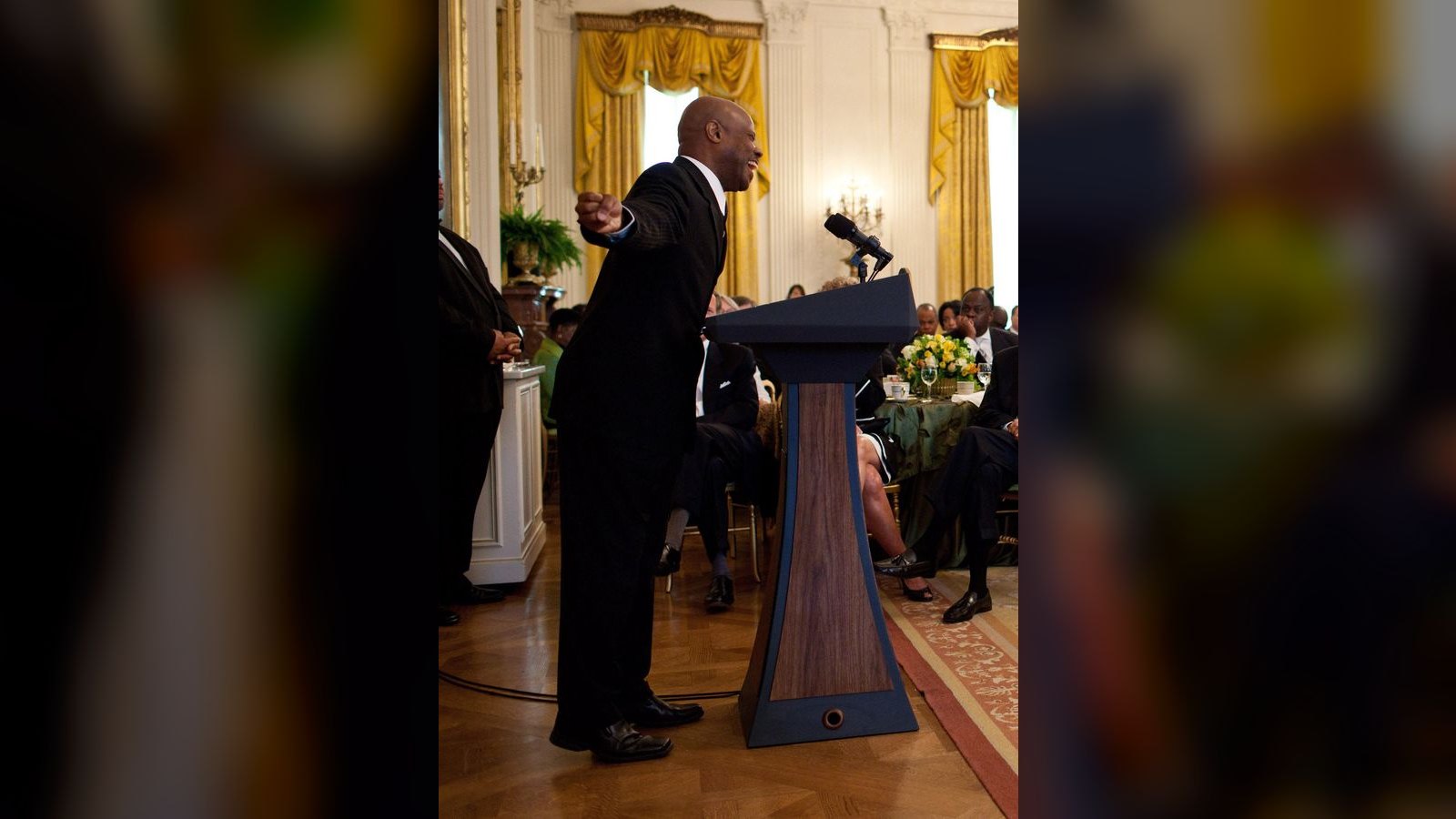
At Carnegie Hall, gospel singer Wintley Phipps delivers perhaps the most powerful rendition of Amazing Grace ever recorded. He is the founder of the U.S. Dream Academy, an after-school and mentoring program for children whose parents are in prison.
Phipps was born January 7, 1955, in Trinidad and Tobago, and received a degree in theology in 1976 from Oakwood College (now Oakwood University), a Seventh-day Adventist school in Huntsville, Alabama. He features a booming baritone voice, usually singing inspirational gospel music. He is an ordained Seventh-day Adventist minister.
At his concert at Carnegie Hall, he spoke about the song before singing it. As one listener transcribed his words, he said, “A lot of people don’t realize that just about all Negro spirituals are written on the black notes of the piano.” He went on to say that the most famous song on this scale was written by John Newton, who used to be the captain of a slave ship, and that many believe Newton heard the melody from slaves. Of that melody, in the same listener’s transcription, he said, “And it has a haunting, haunting plaintive quality to it that reaches past your arrogance, past your pride, and it speaks to that part of you that’s in bondage.” And then: “It’s just one of the most amazing melodies in all of human history.” After sharing the noteworthy history of the song, Mr. Phipps delivers a stirring performance that brings the audience to its feet!
The power of gospel music and his gifted voice have taken the U.S. Dream Academy’s founder and CEO, Wintley Phipps, around the world and placed him before audiences that have included five Presidents of the United States. He has performed for Jimmy Carter, Ronald Reagan, George H.W. Bush, Bill Clinton, and George W. Bush at National Prayer Breakfast events and other celebrations. He has sung at Rosa Parks’ 77th Birthday gala at the Kennedy Center, and for Mother Teresa of Calcutta and former South African President Nelson Mandela. He has appeared on programs such as the Dr. Martin Luther King Jr. television special, Dr. Robert Schuller’s Hour of Power telecast, and the Billy Graham Crusades; at the Vatican; as guest soloist at Diana Ross’s wedding ceremony in Switzerland; and on Saturday Night Live, Soul Train, and The Oprah Winfrey Show. He has conducted lectures in Europe, Australia, Asia, Africa, and North and South America.
About the Dream
The U.S. Dream Academy is helping our nation’s children reach for their dreams. Through academic, social, and values enrichment, we empower those children most at risk of incarceration to believe in themselves and to succeed.
Across the nation, there are millions of young people living in high crime and high poverty communities, who fear they may not live to be an adult. For those young people who also have a parent incarcerated, the future may be even more bleak. For these young people an absent parent, family instability, the stigma and shame of parental incarceration converges with poverty, crime and failing public schools to create a dangerous mix of risk factors that significantly increase a child’s chances of school failure and future incarceration. Without an intervention this cycle will continue.
The Rest of the Story
Added by the Inspire21 editors and checked against the sources below.
Wintley Augustus Phipps was born in Trinidad, in the West Indies, and grew up in Montreal, Canada. After finishing Kingsway College, a Seventh-day Adventist high school near Toronto, he went south to Oakwood College in Alabama. There he studied music theory, began writing gospel music, and met Linda Galloway, who became his wife. They have three sons. He later earned a Master of Divinity at Andrews University.
He has served as senior pastor of churches in the Washington, D.C., area, including the Capitol Hill and Seabrook Seventh-day Adventist churches. In 2023 his publisher listed him as senior pastor of the Palm Bay Seventh-day Adventist Church in Florida. He was nominated for a Grammy Award in 1988 and again in 1989.
In 1998 he founded the U.S. Dream Academy. When AARP honored him with its Purpose Prize, the program was serving 700 students in 15 schools in eight cities. His work has also earned the Oprah Winfrey Angel Network “Use Your Life” award and Philanthropist of the Year from the National Center for Black Philanthropy.
The official video of his Carnegie Hall “Amazing Grace” is labeled 2002. His publisher reports more than ten million views on YouTube.
The words he sang that night belong to John Newton, who lived from 1725 to 1807. Born in Wapping, London, Newton was sailing on his father’s ship in the Mediterranean by age 11. He grew up to captain slave ships and invest in the slave trade.
On March 10, 1748, Newton was steering the ship Greyhound through a fierce storm when he prayed to God. The storm lasted until April 8, and the ship found shelter in Lough Swilly, in the north of Ireland. Newton marked March 10 as an anniversary for the rest of his life. Yet he kept working in the slave trade afterward, and he later said his true conversion came some time after the storm.
In 1764 Newton was appointed to the church at Olney, England. For New Year’s Day, 1773, he wrote a hymn to go with his sermon on 1 Chronicles 17:16–17. That day he led his congregation from the parish church to Lord Dartmouth’s Great Hall in Olney, where the hymn was first sung. It was printed in Olney Hymns in 1779 as “Faith’s Review and Expectation,” six stanzas with no music.
In 1788 Newton published Thoughts upon the African Slave Trade, a graphic account of life on slave ships with a repentant confession of his own part in it. He became a prominent supporter of ending the trade, and Britain abolished it in 1807, a few months before he died.
So who wrote the music? Nobody knows. The hymn has been sung to more than 20 melodies. The one we know, called “New Britain,” was a Southern folk tune printed in 1829 with other words. William Walker, a Baptist song leader, first joined it to Newton’s words in The Southern Harmony in 1835, a book that sold an estimated 600,000 copies. Hymnals list the composer as “unknown,” and according to one listener’s summary of the talk, Phipps told his Carnegie Hall audience he would like to meet that unknown slave in heaven.
Is It True?
- Did Newton hear the melody from slaves on his ship? Doubtful. The tune is an American folk melody first paired with his words in 1835, 28 years after he died. That is Phipps’s belief, not proven history.
- Was the tune composed by a slave? Unproven. The composer is unknown, and the earliest trace is a Southern folk tune printed in 1829.
- Can it be played on the black keys? Yes. The Library of Congress says the melody is built on the five-note scale of the piano’s five black keys, and its earliest form used only those pitches. But that alone does not prove where the tune came from.
- Did Newton quit the slave trade right after the storm and write the hymn? No. He stayed in the trade after 1748, wrote the hymn as a parish minister around 1773, and spoke out against the trade in 1788.
- When was the Carnegie Hall concert? The official video is labeled 2002; one blog says 2007.
In Their Own Words
John Newton’s opening line, as printed in Olney Hymns in 1779: “Amazing grace! (how sweet the sound).”
Phipps, explaining to AARP why he started the Dream Academy: “Children whose parents are incarcerated often perform poorly in school and, if they drop out, face up to 10 times higher odds they will wind up in prison as adults. I founded U.S. Dream Academy, an after-school and mentorship program, for these kids.”
Phipps, in a PBS interview, on what makes the program work: “Just the computers themselves are not going to transform the lives of these kids … The most important part of our program is really the caring, loving adults who surround them.”
A Lesson for Today
- John Newton did not change all at once. Grace often works slowly, and it is never too late to own our past and stand for what is right.
- A hymn written for one New Year’s sermon in Olney has been sung to more than 20 melodies and is still sung today. Faithfulness in one place can reach farther than we imagine.
- Wintley Phipps used his gift to sing and then to serve children with a parent in prison. Ask your group: who near us needs a caring, loving adult?
Sources
- Library of Congress – "The Dissemination of Amazing Grace"
- Museum of the Bible – "'How Sweet the Sound' — Setting the Words to Music (1820s–1920s)"
- Hymnology Archive – "Amazing grace! (how sweet the sound)"
- Cowper & Newton Museum – "Amazing Grace"
- Britannica – "John Newton"
- Tyndale House Publishers – "Wintley Phipps" (author page)
- AARP – "Purpose Prize Winner Wintley A. Phipps"
- Greg Howlett – "Amazing Grace: Debunking a myth"
From inspire21.com/wintley-phipps-amazing-grace/
Did this story lift you up?
Share it with someone
Up next

Here's To The Hero's
This is dedicated to all the men and women who have fought and continue to fight for our freedom. Thank you! Song: "Here's to the Heroes " Artist: The Ten…